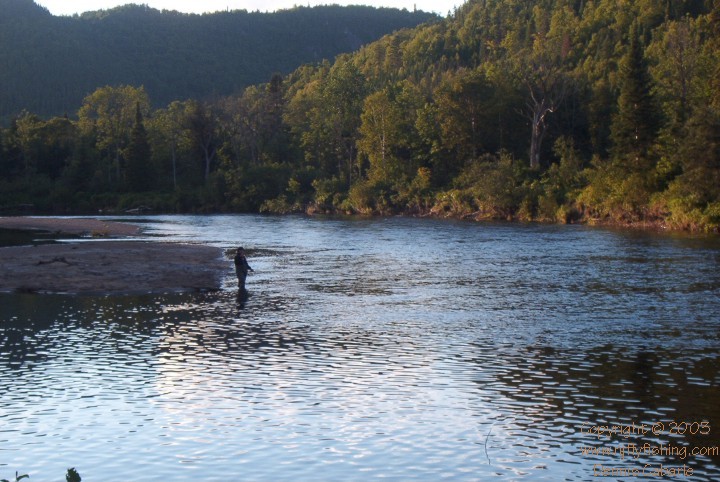
When
new clients arrive on the river in my area, they are often overwhelmed
by the diversity of water on relatively short stretches of river. I like
to point out the different sections or types of water first and explain
the intricacies of each type second.
Too many fly fishers are under the assumption that any stretch of water that normally holds fish is a pool (especially in eastern Canada). I like to be a bit more explicit and speak of riffles, runs, slicks and pools. Mountain creeks such as in the Rockies have their very own types so we won’t get into that. Each water type has its own characteristics, potential, and tactics. For the sake of conversation, let’s describe the 4 general types of water that I’m able to differentiate. Remember, I’m not much of an authority on this subject, so let’s just go with my descriptions for the sake of discussion.
Water Types:
• Riffles:
To me, the riffle looks and sounds like its name, approximately 1 - 2 feet deep, constant current, nice gravel bottom with some nice “boulders” etc sprinkled about. What’s nice about riffles is their capacity to produce bugs. The gravel bottom has lots of “living space” for insects to live. (I’ll let the other members of this site get into the types of insects and other organisms which thrive in this type of water.) Wading is fun.
Note: We have a lot of fun wading through riffles if we can “get out there”. I like to keep my clients up on top of boulders etc to minimize our impact on the river bottom. Try not to go stomping around too much on the “living spaces” of these very rich sites.
• Runs:
This type of water (to me) is essentially a riffle with more current and depth (down to a couple of feet, depending on the current). Because of these two characteristics, the material found here is of larger size. The gravel bottom is composed of larger sized “rocks”. Living spaces are fewer, but still there. Obstacles are more imposing and wading is VERY difficult.
• Slicks:
This is really my interpretation, but for me a slick is a run so deep that the surface is only occasionally influenced by the subsurface characteristics. We’ll only see an occasional up welling to indicate a large obstacle for instance.
• Pools:
Once a slick gets so deep that the current can
back eddy (horizontally as well as vertically), I’m into a pool.
Pools have a distinct head, body and tail.
We can’t really start looking at the morphology of a type of water without getting into a bit of “fish” biology/psychology and stream ecology, so I think this thread will have to run on two fronts at the same time. After all, we don’t try to read water for the fun of it. The object is to possibly divulge where the fish are and to figure out what to present and how to present it to them. How do we go about this?
The first trick that many clients forget about while looking at a run (that is, if they don’t go stomping into the pool before looking) is that they only “look” at the water. I like to try to imagine what is under the surface. You can only do this by analyzing the surface by noting the water movement, the currents, and finally by visualizing what lies underneath. *(Polarized sunglasses help too). Each of these signs helps indicate to me where a fish could be or even where fish probably won’t be, which leads us to our next section.
Where wouldn’t a fish be? Think about it, what do fish look for in a station (or lie I suppose we say in the US)? If I were a fish, I’d either be looking for food or looking for an easy place to relax which provides me with shelter from predators. Let’s look at three different qualities of each station.
Looking for food in a river would be much too hard on an energy budget to roam around in a run looking for food. It appears that foraging fish (not Atlantic Salmon) prefer to position themselves in a sheltered position waiting for food to drift/swim by. These “feeding” stations are often the first points of reference that fly fishermen learn to recognize.
Feeding stations in a riffle are few and far between. Why? Well, remember there isn’t a lot of water depth in a riffle. A fish holding in a riffle is pretty vulnerable to predation. The surface of a riffle is broken, but the depth isn’t there. A fish holding in a riffle REALLY wants to eat. (Good for us!).
When we get into a run, the water is deeper and fish could be more inclined to hold longer in a specific area. Proportionally, in a run versus a riffle, the stations are larger and can hold a LARGER fish. It is also once we start getting water depths of runs that real hydraulic effects can start to be found. That is, a fish doesn’t need to hold BEHIND an obstacle, it can hold along side a boulder or even in front of it. (Picture a Nascar driver holding on the “compression wave” of the car behind him.) This also means that a fish can use the bottom as well as the banks to find “effects” that will help it to hold on station.
Slicks to me come in two variants, alive or dead. A dead slick is too barren without cover and too much current without bottom features. We often see people fishing dead slicks because they don’t take the time to spool up, walk along the bank and scout out the section.
Live slicks have enough obstacles to hide some fish, but I often find targets to be very wary in these waters. Pools are the sections of water that typically hold the largest fish. Happily, I have also found that in situations where the current is less, larger fish will ‘tolerate’ schooling. As mentioned earlier, pools have a distinct head, body, and tail. I have found that the bruisers can hold just back of the head and often just up from the tail. I really don’t like wet tips and lead so I rarely prospect the body of a pool (even though I’m sure that I pass up some nice opportunities).
Presentation in a pool is probably more important than anything else when on the river. Almost like still water fishing, the fish can take their time and inspect our meager offerings. Out in the current, fish don’t have time to check out a fly. They take or they refuse. In pools, the fun starts. Refusals are common. Splashy rises right next to the fly. Bumping, …, are all part of the game! This is why I like fishing the head and tail of a pool. A bruiser holding just back from the head waiting for something to drift down from the upstream run can’t let everything go by as there are probably others waiting in the body of the pool too. The same can be said for the tail of a pool. If the fish lets something go by, it can’t chase it down … too much energy would be wasted.
 About the Author:
Chris Chin is originally
from Kamloops, British Columbia. He has been fly fishing on and off ever
since he was 10 years old. Chris became serious about the sport within
the last 10 years.
“I'm a forest engineer by day and part time guide on the Ste-Marguerite
River here in central Quebec. I've been fishing this river for about 8
years now and started guiding about 3 years ago when the local guide's
association sort of stopped functioning.”
Chris guides mostly for sea run brook trout and about 30% of the time
for Atlantic Salmon. “I often don't even charge service fees, as
I'm more interested in promoting the river than making cash. I like to
get new comers to realize that salmon fishing is REALLY for anyone who
cares to try it. Tradition around here makes some of the old clan see
Salmon fishing as a sport for the rich. Today our shore lunches are less
on the cucumber sandwich side and more toward chicken pot pie and Jack
Daniel's.”
Chris is 40 years old as of this writing. He is of Chinese origin although
his parents were born and raised in Jamaica. He has a girlfriend, Renée.
“She and her 12 year old son Vincent started fly fishing with me
last October.”
Article and all photo's by Chris Chin
Copyright ©2004, North Eastern Fly
Fishing Forums, njflyfishing.com, neflyfishing.net